Unshaken Optimism Staying invested through market uncertainty

September 24, 2024

A Message from Mike

A perennial bull’s view on the year that was, and the case for staying invested


Every year around this time, someone asks me the same question, usually with a half-smile that tells me they already know the answer: “So Mike, are you still bullish?” And every year I give them the same reply. Yes. I always am, and I make no apology for it.

I have spent fifteen years watching money move through markets, and if there is one lesson that has earned its place at the front of my thinking, it is this: the long-term direction of good businesses, in good markets, run by capable people, is up. Not in a straight line. Not without stretches that test your patience and occasionally your stomach. But up. The person who bets against human progress, against innovation, against the sheer determination of well-run companies to grow and adapt, has a poor track record over any meaningful period. I have no intention of joining them.

That is not blind optimism, and I want to be clear about the distinction, because the two get confused. Blind optimism ignores risk. What I do is the opposite. I spend a great deal of my time thinking about what could go wrong, precisely so that when it does, we are positioned to hold our nerve rather than reach for the sell button. Being a perennial bull is not about pretending the road is smooth. It is about knowing where the road leads, and refusing to be shaken off it by every pothole along the way.


The year that tried to talk you out of it

FY26 was, by any measure, a year designed to test that conviction. George covers the detail in the pages that follow, MICHAEL SMITH Portfolio Manager & CEO and he does it well, so I will not tread on his ground. But at a high level, we lived through a geopolitical flare-up in the Middle East, an oil price that spiked and then just as quickly reversed, a run of interest rate rises before a central bank finally paused,and a domestic share market that spent much of the year going sideways while sentiment lurched from one headline to the next.

If you had watched only the news, you would have been forgiven for wanting to sit the whole thing out. And that, in a sentence, is the trap. Because the investors who did best through FY26 were not the ones who correctly predicted which headline would arrive next. Nobody did that. They were the ones who stayed in their seats. They were the ones who understood that volatility is the price of admission, not a reason to leave the theatre.

I say this a lot, and I will keep saying it: my job, and the job of every adviser in this business, is to keep you invested and on track. That sounds simple. It is not. The hardest thing an investor ever does is nothing, especially when every instinct and every screen is screaming at them to act. A large part of the value we add is not in the clever trade. It is in the steadying hand at the exact moment that steadiness is least comfortable and most valuable. FY26 gave us plenty of those moments, and I am proud of how our clients came through them.


What I actually spend my days doing

Most of my working hours are given to our flagship strategy, the Global Growth portfolio. It is the strategy I know best, the one I think about in the shower and occasionally at three in the morning, and it is the clearest expression of how I believe long-term wealth is built. So let me pull back the curtain a little, because I think it helps to understand not just what we own, but why we own it and why we hold on when others let go.

The first thing you would notice about the portfolio is that its largest single position, at a little over eleven per cent, is Taiwan Semiconductor. That is a deliberate statement, not an accident. Taiwan Semiconductor makes the most advanced chips on the planet, and very little of the technology that will define the next decade, from artificial intelligence to advanced computing, gets built without them. Yes, the company sits in one of the most geopolitically sensitive locations in the world, and no, I do not dismiss that risk. But I would rather own the best business in a difficult neighbourhood, sized sensibly and watched closely, than settle for a lesser company for the sake of an easier story. Conviction means owning the thing thatmatters, and understanding the risk you are taking to own it.

Around that anchor sits what I think of as the engine room of the portfolio. Nvidia, Advanced Micro Devices, ASML, alongside the large platform businesses like Microsoft, Alphabet, Amazon and Meta. Together these represent our belief that the build- out of artificial intelligence and the infrastructure beneath it is ,not a passing enthusiasm but a genuine, multi-year shift in how the world computes. That is where a meaningful share of the portfolio’s growth potential lives, and it is the part that carried a great deal of the load this year while our home market marked time.

But an engine without ballast is just a fast way to have an accident. So the portfolio is deliberately built as a barbell. On one side, the growth. On the other, a foundation of some of the most durable, cash-generative businesses in the world. Berkshire Hathaway, at seven and a half per cent, is our great stabiliser, a collection of quality assets with a fortress balance sheet and a culture of discipline I admire enormously. Costco, at seven per cent, is a business that people keep spending with in good times and bad. Procter and Gamble, McDonald’s, Visa. These are not the names that make headlines, and that is exactly the point. They are the keel that keeps the boat upright when the growth engine runs into weather.

And then there is a quieter thread that ran right through this particular year. We hold RTX and Northrop Grumman, two of the world’s leading defence businesses. In a year defined by geopolitical tension, those holdings were a reminder that a well-built portfolio does not need to guess the next crisis to be prepared for it. It simply needs to be diversified across the forces actually shaping the world, so that when one part of the market is under pressure, another is doing its job. That is not luck. That is construction.

I lay all of this out not to give you a shopping list, but to show you the thinking. Every position in the Global Growth portfolio earns its place. When markets wobble, and they will, I want you to know that behind the ticker symbols sits a deliberate architecture built to endure exactly the kind of year we just had.


Why I stay in my seat, and why you should too

Here is the uncomfortable truth about market timing: to get it right, you have to be right twice. You have to sell at the right moment and then buy back at the right moment, and you have to do both while every emotion you have is pulling you in the wrong direction. In fifteen years I have met very few people who can do this reliably, and I am not one of them. Neither, I would gently suggest, is anyone selling you a newsletter that promises they can.

So we do the boring, unglamorous, deeply effective thing instead. We stay invested. We diversify across geographies, sectors and the structural forces shaping the decade ahead. We rebalance with discipline rather than emotion. And we let the extraordinary power of quality businesses compounding over time do the heavy lifting. It is not exciting. It is not clever. It just works, and it has worked for as long as markets have existed.

If FY26 taught us anything, it is that the reward for patience is not always immediate, but it is real. The clients who stayed the course through a difficult, noisy year are the ones best placed to benefit from what comes next. And I remain, as ever, deeply optimistic about what comes next.


Looking into FY27

I will not pretend to know what the next twelve months hold. Nobody does. I can almost promise you there will be a scare or two, a headline that makes you want to reach for the phone, a stretch where the portfolio does not move the way we would like. That is not a bug in investing. It is the feature that makes the long-term returns possible in the first place.

What I can promise is that we will not be talked out of a sound long-term plan by short-term noise. We will keep you invested. We will keep you diversified. We will keep watching the businesses we own with the seriousness they deserve. And when the moments of doubt arrive, as they always do, we will be here to remind you why we are positioned the way we are.

I have been bullish for fifteen years, and the world has done its level best to talk me out of it more than once. It has never succeeded, because the evidence keeps landing on the side of the optimists. I see no reason for FY27 to be the exception.

Thank you, as always, for your trust. It is the thing we value most, and the thing we work hardest to deserve.

BUSINESS
July 5, 2026
Tagged:
Markets

Unshaken Optimism Staying invested through market uncertainty

Accounting Solutions Tailored to Your Needs, Your Go-To Source for Accounting Knowledge and Tools.
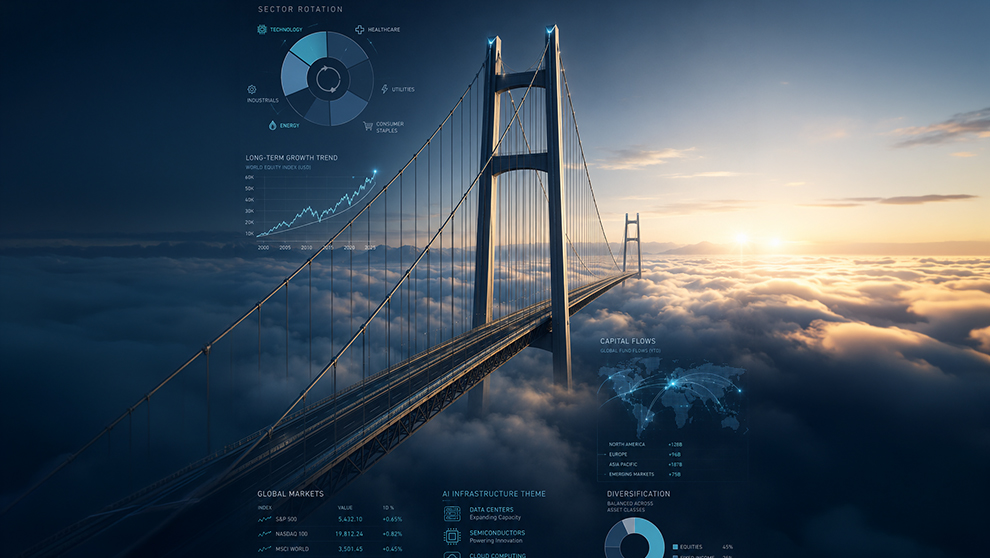
Bridge above clouds at sunrise with financial data overlays, symbolizing steady investing through market uncertainty.

A Message from Mike

A perennial bull’s view on the year that was, and the case for staying invested


Every year around this time, someone asks me the same question, usually with a half-smile that tells me they already know the answer: “So Mike, are you still bullish?” And every year I give them the same reply. Yes. I always am, and I make no apology for it.

I have spent fifteen years watching money move through markets, and if there is one lesson that has earned its place at the front of my thinking, it is this: the long-term direction of good businesses, in good markets, run by capable people, is up. Not in a straight line. Not without stretches that test your patience and occasionally your stomach. But up. The person who bets against human progress, against innovation, against the sheer determination of well-run companies to grow and adapt, has a poor track record over any meaningful period. I have no intention of joining them.

That is not blind optimism, and I want to be clear about the distinction, because the two get confused. Blind optimism ignores risk. What I do is the opposite. I spend a great deal of my time thinking about what could go wrong, precisely so that when it does, we are positioned to hold our nerve rather than reach for the sell button. Being a perennial bull is not about pretending the road is smooth. It is about knowing where the road leads, and refusing to be shaken off it by every pothole along the way.


The year that tried to talk you out of it

FY26 was, by any measure, a year designed to test that conviction. George covers the detail in the pages that follow, MICHAEL SMITH Portfolio Manager & CEO and he does it well, so I will not tread on his ground. But at a high level, we lived through a geopolitical flare-up in the Middle East, an oil price that spiked and then just as quickly reversed, a run of interest rate rises before a central bank finally paused,and a domestic share market that spent much of the year going sideways while sentiment lurched from one headline to the next.

If you had watched only the news, you would have been forgiven for wanting to sit the whole thing out. And that, in a sentence, is the trap. Because the investors who did best through FY26 were not the ones who correctly predicted which headline would arrive next. Nobody did that. They were the ones who stayed in their seats. They were the ones who understood that volatility is the price of admission, not a reason to leave the theatre.

I say this a lot, and I will keep saying it: my job, and the job of every adviser in this business, is to keep you invested and on track. That sounds simple. It is not. The hardest thing an investor ever does is nothing, especially when every instinct and every screen is screaming at them to act. A large part of the value we add is not in the clever trade. It is in the steadying hand at the exact moment that steadiness is least comfortable and most valuable. FY26 gave us plenty of those moments, and I am proud of how our clients came through them.


What I actually spend my days doing

Most of my working hours are given to our flagship strategy, the Global Growth portfolio. It is the strategy I know best, the one I think about in the shower and occasionally at three in the morning, and it is the clearest expression of how I believe long-term wealth is built. So let me pull back the curtain a little, because I think it helps to understand not just what we own, but why we own it and why we hold on when others let go.

The first thing you would notice about the portfolio is that its largest single position, at a little over eleven per cent, is Taiwan Semiconductor. That is a deliberate statement, not an accident. Taiwan Semiconductor makes the most advanced chips on the planet, and very little of the technology that will define the next decade, from artificial intelligence to advanced computing, gets built without them. Yes, the company sits in one of the most geopolitically sensitive locations in the world, and no, I do not dismiss that risk. But I would rather own the best business in a difficult neighbourhood, sized sensibly and watched closely, than settle for a lesser company for the sake of an easier story. Conviction means owning the thing thatmatters, and understanding the risk you are taking to own it.

Around that anchor sits what I think of as the engine room of the portfolio. Nvidia, Advanced Micro Devices, ASML, alongside the large platform businesses like Microsoft, Alphabet, Amazon and Meta. Together these represent our belief that the build- out of artificial intelligence and the infrastructure beneath it is ,not a passing enthusiasm but a genuine, multi-year shift in how the world computes. That is where a meaningful share of the portfolio’s growth potential lives, and it is the part that carried a great deal of the load this year while our home market marked time.

But an engine without ballast is just a fast way to have an accident. So the portfolio is deliberately built as a barbell. On one side, the growth. On the other, a foundation of some of the most durable, cash-generative businesses in the world. Berkshire Hathaway, at seven and a half per cent, is our great stabiliser, a collection of quality assets with a fortress balance sheet and a culture of discipline I admire enormously. Costco, at seven per cent, is a business that people keep spending with in good times and bad. Procter and Gamble, McDonald’s, Visa. These are not the names that make headlines, and that is exactly the point. They are the keel that keeps the boat upright when the growth engine runs into weather.

And then there is a quieter thread that ran right through this particular year. We hold RTX and Northrop Grumman, two of the world’s leading defence businesses. In a year defined by geopolitical tension, those holdings were a reminder that a well-built portfolio does not need to guess the next crisis to be prepared for it. It simply needs to be diversified across the forces actually shaping the world, so that when one part of the market is under pressure, another is doing its job. That is not luck. That is construction.

I lay all of this out not to give you a shopping list, but to show you the thinking. Every position in the Global Growth portfolio earns its place. When markets wobble, and they will, I want you to know that behind the ticker symbols sits a deliberate architecture built to endure exactly the kind of year we just had.


Why I stay in my seat, and why you should too

Here is the uncomfortable truth about market timing: to get it right, you have to be right twice. You have to sell at the right moment and then buy back at the right moment, and you have to do both while every emotion you have is pulling you in the wrong direction. In fifteen years I have met very few people who can do this reliably, and I am not one of them. Neither, I would gently suggest, is anyone selling you a newsletter that promises they can.

So we do the boring, unglamorous, deeply effective thing instead. We stay invested. We diversify across geographies, sectors and the structural forces shaping the decade ahead. We rebalance with discipline rather than emotion. And we let the extraordinary power of quality businesses compounding over time do the heavy lifting. It is not exciting. It is not clever. It just works, and it has worked for as long as markets have existed.

If FY26 taught us anything, it is that the reward for patience is not always immediate, but it is real. The clients who stayed the course through a difficult, noisy year are the ones best placed to benefit from what comes next. And I remain, as ever, deeply optimistic about what comes next.


Looking into FY27

I will not pretend to know what the next twelve months hold. Nobody does. I can almost promise you there will be a scare or two, a headline that makes you want to reach for the phone, a stretch where the portfolio does not move the way we would like. That is not a bug in investing. It is the feature that makes the long-term returns possible in the first place.

What I can promise is that we will not be talked out of a sound long-term plan by short-term noise. We will keep you invested. We will keep you diversified. We will keep watching the businesses we own with the seriousness they deserve. And when the moments of doubt arrive, as they always do, we will be here to remind you why we are positioned the way we are.

I have been bullish for fifteen years, and the world has done its level best to talk me out of it more than once. It has never succeeded, because the evidence keeps landing on the side of the optimists. I see no reason for FY27 to be the exception.

Thank you, as always, for your trust. It is the thing we value most, and the thing we work hardest to deserve.

The Advice Desk


Peace, Rotation, and the End of a Surprising Financial Year

What June revealed, and what it means heading into FY27

In fifteen years advising through market cycles, I’ve seen plenty of financial years end quietly and a few end with a bang. FY26 managed to do both, and it changed character in a single morning.


The Deal That Moved a Market

On June 15, US President Donald Trump announced a framework peace deal with Iran, including a commitment to reopen the Strait of Hormuz. Markets moved before the detail was even known. The ASX 200 rose around 1.5% on the day, US markets followed overnight, and oil, which had been sitting near US$118 a barrel, fell roughly 14 to 15% almost immediately.

The important word in that announcement is framework. This is not a signed, durable settlement, and the tensions that pushed oil to US$118 in the first place have not disappeared. The Strait has moved in and out of the market’s risk calculations more than once this year. Markets have priced in peace; they have not priced in it holding. For anyone positioning a portfolio into FY27, that distinction matters more than the day-one rally.


The Energy Reversal

For the ASX’s energy sector, the standout performer of early 2026 while oil was elevated, the peace deal was a sharp reversal. The energy index fell nearly 9% across June, with Woodside, Santos and Origin all declining as analysts marked down forward revenue assumptions.

At the same time, the sectors that had spent the year under pressure from expensive oil and persistent inflation recovered strongly. Consumer Staples, the defensive, everyday-spending part of the market, rose more than 12% in the month and finished as the best-performing sector on the ASX for the full financial year. Healthcare, under real strain for much of 2026, gained more than 13% in June alone.

That rotation, with money moving out of energy and into consumer and healthcare almost overnight, is one of the clearest illustrations this year of why we don’t concentrate portfolios in a single year’s winner. The names leading the market in January were not the names leading it in nJune. They rarely are.


The RBA Steps to the Sidelines

A week after the peace deal, the RBA met and voted unanimously to hold the cash rate at 4.35%. After three consecutive hikes in February, March and May, the pause was widely welcomed. The fall in oil had taken some heat out of the near-term inflation outlook, though Governor Bullock was careful to note that the pass-through from earlier energy costs will take time to fully resolve.


The Board ruled nothing in or out for August. For borrowers, the hold was a relief. For investors, it’s a signal that we are at or near the top of this tightening cycle, not that rate cuts are imminent. Given the oil picture could reverse again, I’d treat any assumption of near-term easing with caution.

A Year That Rewarded Patience

Step back from the month-to-month noise and FY26 was a modest year for Australian shares. The ASX 200 finished up around 3% on price, or roughly 6.3% once dividends are included, comfortably below the long-run average nearer 8 to 9%. On a total-return basis, we ranked 16th of 20 major global markets. Not a year for the record books.

But that figure only tells half the story. FY26 absorbed an unusual amount of volatility: the Iran conflict that flared in late February, three rate hikes, a significant federal budget, and a sector rotation following nearly every one of those events. Through all of it, the investors who fared best were not those reacting to each headline. They were those who stayed diversified and stayed invested.

It also explains why the ASX result understates how diversified clients actually performed. Portfolios carrying international exposure, particularly US technology, cybersecurity and AI infrastructure, did considerably better than the local index, as US markets meaningfully outpaced our own this year. Geographic diversification is not a box we tick for appearance’s sake. It is the reason a soft year at home was not a soft year in a well-constructed portfolio.


What’s Happening in the Advice World
With FY27 now underway, this is one of the best windows in the calendar to review your overall position, and there’s a concrete reason to do so now.

Superannuation contribution caps have reset. The concessional (pre-tax) cap has risen to $32,500 and the non-concessional cap to $130,000 for FY27. If you underused your caps in recent years and your total super balance is below $500,000, carry-forward concessional contributions may also still be available, a useful lever, particularly in a higher-income year. With the budget having made super relatively more attractive than investing outside it, this is worth a considered conversation rather than a task left until June.

If you’re unsure where you stand, that’s exactly what we’re here for. A short conversation now is worth far more than a scramble later in the year.

Growthfront Portfolio Performance

Your monthly snapshot of portfolio returns and performance trends.
PORTFOLIO PERFORMANCE AS OF 30 June 2026
1 month
3 months
6 months
1 year (p.a.)
3 years (p.a)
Conservative investor risk profile - risk level 3 out of 7
Haven Portfolio (Conservative)
2.4%
6.5%
4.9%
10.0%
9.6%
Meredian Portfolio (Balanced)
2.1%
10.3%
6.1%
13.3%
13.2%
Summit Portfolio (Growth)
2.0%
11.5%
6.5%
14.2%
14.1%
Aurora Portfolio (High Growth)
2.1%
12.6%
6.8%
15.0%
15.0%
Horizon Portfolio (GlobalGrowth)
3.6%
16.9%
7.5%
14.1%
15.0%
Performance figures are shown after fees and are based on the underlying returns of each portfolio.
George Wong - Senior Investment Advisor at Growthfront Wealth Management
GEORGE WONG
Senior Investment Advisor
Follow us on:
Growthfront on FacebookGrowthfront on TwitterGrowthfront on InstagramGrowthfront on LinkedInGrowthfront on YouTube

Join our newsletter for tips & insights

Thank you! Your submission has been received!
Oops! Something went wrong while submitting the form.
Growthfront licensed financial advisers
Receive the free Growthfront monthly newsletter and updates
Thank you! Your submission has been received!
Oops! Something went wrong while submitting the form.
This site is protected by reCAPTCHA and the Google Privacy Policy and Terms of Service apply.

Disclaimer:
Growthfront Pty Ltd is a Corporate Authorised Representative (No. 1302922) of Geosmith Partners AFSL 700062 ABN 86 684 092 135. Any advice contained in this website is general advice only and has been prepared without considering your objectives, financial situation or needs except in circumstances where you have provided your personal financial details via our online application process and received a Statement of Advice from us. Before making any investment decision we recommend that you consider whether it is appropriate for your situation and seek appropriate taxation and legal advice. Please read our Financial Services Guide before deciding whether to obtain financial services from us